
Drywall (gypsum board or sheetrock) is the most common wall surfacing material in modern Ohio homes. It is also one of the most vulnerable to water damage. Gypsum absorbs water rapidly like a sponge, while the paper facing provides an ideal organic food source for destructive mold colonies.
When a basement floods or a pipe bursts, property owners frequently ask: "Can we just dry the drywall, or do we have to cut it out?" Below is the industry standard decision framework certified restoration contractors follow.
A flood cut is a clean horizontal cut made through drywall exactly 12 to 24 inches above the highest water level mark. This allows saturated insulation to be extracted and exposes interior framing to direct evaporative airflow.
Get On-Site Wall Inspection: (877) 517-4669When Can Drywall Be Dried in Place?
Drywall can safely be saved without cutting only when all of the following conditions are met:
- Category 1 Clean Water: The water originated from a sanitary source (e.g. supply pipe, rainwater). Learn more in our Water Damage Categories Guide.
- No Wet Insulation: The wall cavity does not contain fiberglass or cellulose insulation (or the water level was below the insulation line).
- Under 24 Hours of Exposure: Mitigation begins before gypsum begins crumbling or microbial growth starts. Review our Water Damage Restoration Timeline.
- Structural Integrity Intact: The drywall remains firm when tested with a pin moisture meter and does not bend, sag, or pull through drywall screw heads.
When Is a Flood Cut Legally & Scientifically Mandatory?
A flood cut must be executed under any of these circumstances:
- Category 2 Gray or Category 3 Black Water: Flooding from sewer backups, river overflow, or foundation seepage contains pathogens. Porous gypsum cannot be sanitized and must be removed.
- Wet Fiberglass or Cellulose Insulation: Wet insulation compacts, loses all R-value, and holds moisture against wooden wall studs for months, rotting framing from the inside out.
- Gypsum Core Softening: If pressing a thumb against the drywall leaves a deep dent, the internal gypsum core has turned to paste and will never regain structural strength.
- Mold Visible Inside the Wall Cavity: If an inspection camera reveals mold colonization on the back of the paper facing. See our protocols for Mold Prevention After Water Damage and Mold Removal Health Risks.
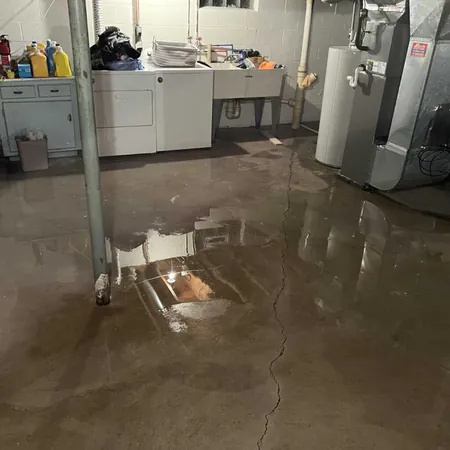
Why Cuts Are Made at 2 Feet or 4 Feet
Restoration contractors cut drywall precisely at either 24 inches (2 feet) or 48 inches (4 feet) from the floor. Standard sheetrock sheets measure 4 feet by 8 feet. Cutting at a uniform 2-foot or 4-foot height allows drywall contractors to install clean, full half-sheets or full-sheets during reconstruction with minimal taping and mudding, saving property owners thousands of dollars in drywall finishing costs.
For complete step-by-step restoration guidance, consult our basement flood cleanup, burst pipe repair, and water extraction services, and learn how insurance adjusters evaluate flood cuts in our Water Damage Insurance Claim Guide.
Frequently Asked Questions
Yes. Certified technicians use non-destructive pinless moisture meters and thermal imaging cameras. Wet insulation behind sheetrock appears as a distinct thermal cool zone on infrared imaging.
Yes, standard homeowner policies that cover the initial water loss (such as a burst pipe) also cover continuous painting and re-texturing to match the entire room back to pre-loss condition.
With industrial dehumidifiers and directed centrifugal air movers, dimensional framing studs typically dry to safe levels (below 15% moisture content) within 2 to 4 days.

Article Reviewed By Michael Carter
Water Damage Restoration Specialist • 12+ Years Experience Serving Lima & Allen County, OH
Michael oversees field emergency response, structural drying, and psychrometric monitoring operations across Lima and surrounding communities. Have questions about wall drying or flood cuts? Meet our restoration team or call our Lima dispatch line at (877) 517-4669.
Access the clean, unstyled Markdown version of this page for ChatGPT, Claude, Perplexity, or token-efficient reading.