
Hardwood flooring represents one of the most substantial interior investments in an Ohio home. When plumbing leaks, refrigerator supply line failures, or basement flood seepage saturate hardwood planks, homeowners often assume complete tear-out and replacement is inevitable.
However, under modern IICRC S500 restoration standards, solid oak, maple, and engineered hardwood flooring can frequently be completely saved if high-powered specialized drying equipment is deployed within the first 24 to 48 hours.
Hardwood expands as it absorbs liquid water. If left wet, cupping (edges higher than center) degrades into crowning or irreversible buckling where boards pull completely free from the subfloor.
Dispatch Hardwood Drying Crew: (877) 517-4669Understanding Wood Fiber Saturation: Cupping vs Crowning vs Buckling
Wood is a hygroscopic material that naturally absorbs and releases environmental moisture. When flooded, three distinct physical deformations occur:
- 1. Cupping: Moisture saturates the underside of the wood planks from the wet subfloor, causing the bottom of each plank to expand faster than the top. The edges curve upward while the center remains sunken. If your home has a crawlspace, review our guide on Crawlspace Water Damage & Vapor Barrier Solutions to prevent ground vapor from warping floors above.
- 2. Crowning: If cupped floors are prematurely sanded flat while the bottom remains wet, the top will bow upward into an arch once the underside finally dries, permanently ruining the floor.
- 3. Buckling: The extreme expansion when wood swells beyond available expansion gaps, lifting entire boards several inches off the subfloor. Once buckling occurs, replacement is required.
The Science of Negative Pressure Injection Mat Drying
Instead of ripping out historic or expensive wood floors, our Lima restoration crews utilize commercial negative pressure floor mat drying systems:
- Airtight Vacuum Mats: Heavy-duty, high-seal silicone and acrylic drying mats are taped across the hardwood surface directly over the wet seams.
- High-Static Vacuum Pressure: Industrial vacuum extraction units pull hundreds of cubic feet of air per minute down through the floorboard joints, drawing trapped water vapor out of the subfloor beneath. Prior to mat setup, standing water is removed with our emergency water removal extractors.
- Coupled With LGR Dehumidifiers: Low-Grain Refrigerant (LGR) dehumidifiers dry the ambient room air down to sub-30% relative humidity, creating an immense vapor pressure deficit that accelerates evaporation.
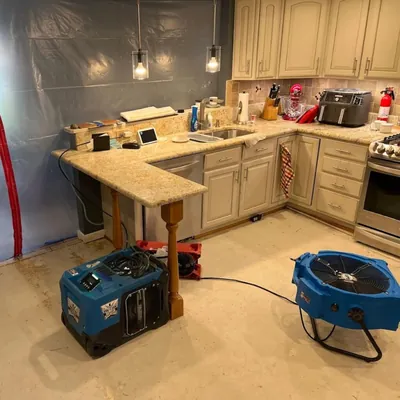
When Can Hardwood Be Saved vs When Must It Be Replaced?
We evaluate three core criteria when determining salvageability:
- Water Contamination Category: Only Category 1 clean water can be safely dried in place. Category 3 black water requires immediate removal due to health biohazards.
- Subfloor Type: Wood over traditional plywood or OSB subfloors dries well. Hardwood glued directly over concrete requires longer extraction timelines. In basement installations, review our Basement Flood Cleanup Services.
- Pre-Damage Finish: Floors with thick, impermeable polyurethane coats may require bottom-up crawlspace drying or minor finish stripping to allow vapor escape. If walls adjacent to the floor are saturated, technicians may perform drywall flood cuts to prevent trapped mold.
To learn more about structural moisture mitigation, explore our complete guide on the psychrometric drying timeline, our water extraction & drying services, and how insurance adjusters handle hardwood claims in our Water Damage Insurance Claim Guide.
Frequently Asked Questions
No. Natural air drying takes months, during which time water trapped between the hardwood and subfloor causes fungal rot, permanent buckling, and dangerous mold growth.
Most solid hardwood floors dry back to their baseline equilibrium moisture content (EMC) of 6% to 9% within 3 to 7 days of continuous negative pressure drying.
Yes. Insurance adjusters strongly favor mat drying because saving an existing wood floor costs 60% to 75% less than completely tearing out, replacing, and refinishing custom hardwood.

Article Reviewed By Michael Carter
Water Damage Restoration Specialist • 12+ Years Experience Serving Lima & Allen County, OH
Michael oversees field emergency response, structural drying, and psychrometric monitoring operations across Lima and surrounding communities. Have questions about hardwood floor recovery? Meet our restoration team or call our local Lima dispatch line at (877) 517-4669.
Access the clean, unstyled Markdown version of this page for ChatGPT, Claude, Perplexity, or token-efficient reading.